About
Hydrogels in Concrete
Our leading contributions to the materials engineering community center on the design, characterization, and application of hydrogel particles as internal curing agents for high-performance concrete. Our group was among the first to systematically connect a hydrogel’s polymeric network structure to how effectively it releases water inside real cementitious systems. Supported by an NSF CAREER award, we developed multifunctional composite hydrogels containing silica, which both reduce shrinkage during curing and promote the formation of strong, durable cement phases. More recent work, funded by the Indiana Department of Transportation, demonstrated that hydrogel internal curing agents can maintain or even enhance the strength and durability of paste, mortar, and concrete in real-world applications. Currently, we are incorporating organic silane molecules into the polymer network to tailor the development of cement hydrates as well as exploring low-cost SAPs produced from upcycled absorbent materials from diaper manufacturing. Click here for more details.
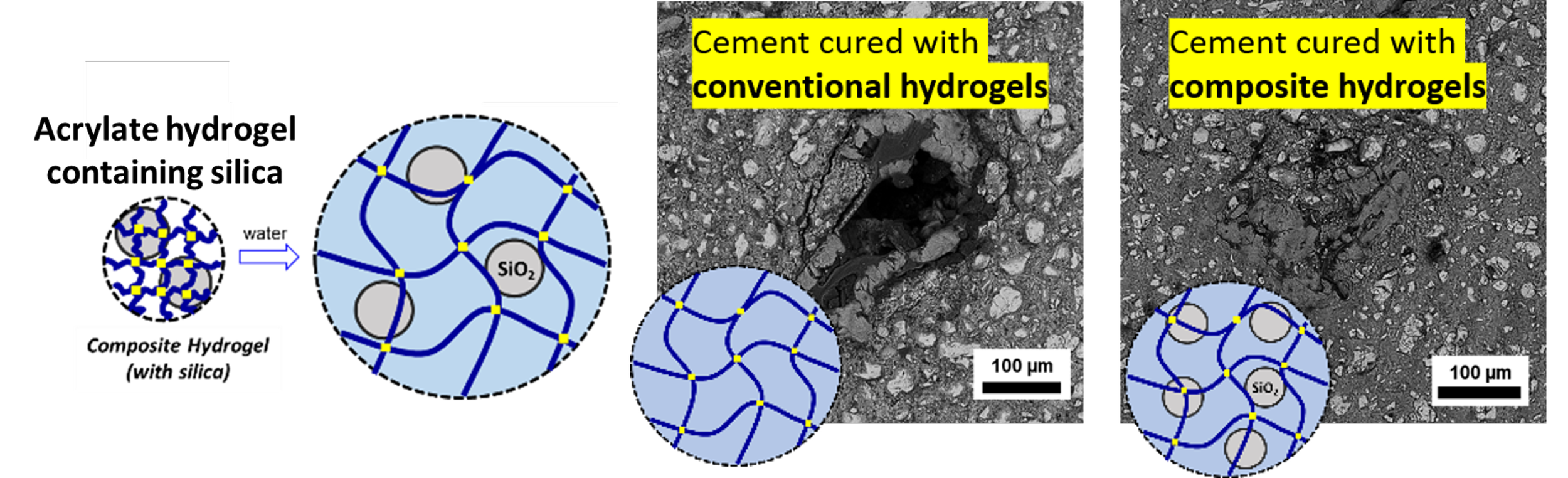
Microstructural refinement of cement paste internally cured by polyacrylamide composite hydrogel particles containing silica fume and nanosilica (Bose, Davis, and Erk, Cement and Concrete Research 2021).
The Rheology of Concentrated Surfactants
Our rheology research advances the fundamental understanding of how surfactant mixtures used in cleaning products behave under flow, providing insight that supports the development and processing of more sustainable, highly concentrated formulations. Our group built two custom flow-velocimetry systems that integrate with our Anton Paar shear rheometer: an optical system for transparent fluids and an ultrasound system for opaque ones. Using this specialized instrumentation, we demonstrated that the commonly observed “shear thinning” in surfactant solutions often arises from nonuniform flow behaviors, including phenomena such as wall slip and shear banding. In a long-standing collaboration with The Procter & Gamble Company, and with support from an NSF GOALI award, our group is now investigating how small-molecule additives influence the microstructure and rheology of more concentrated, and more sustainable surfactant systems. Click here for more details.
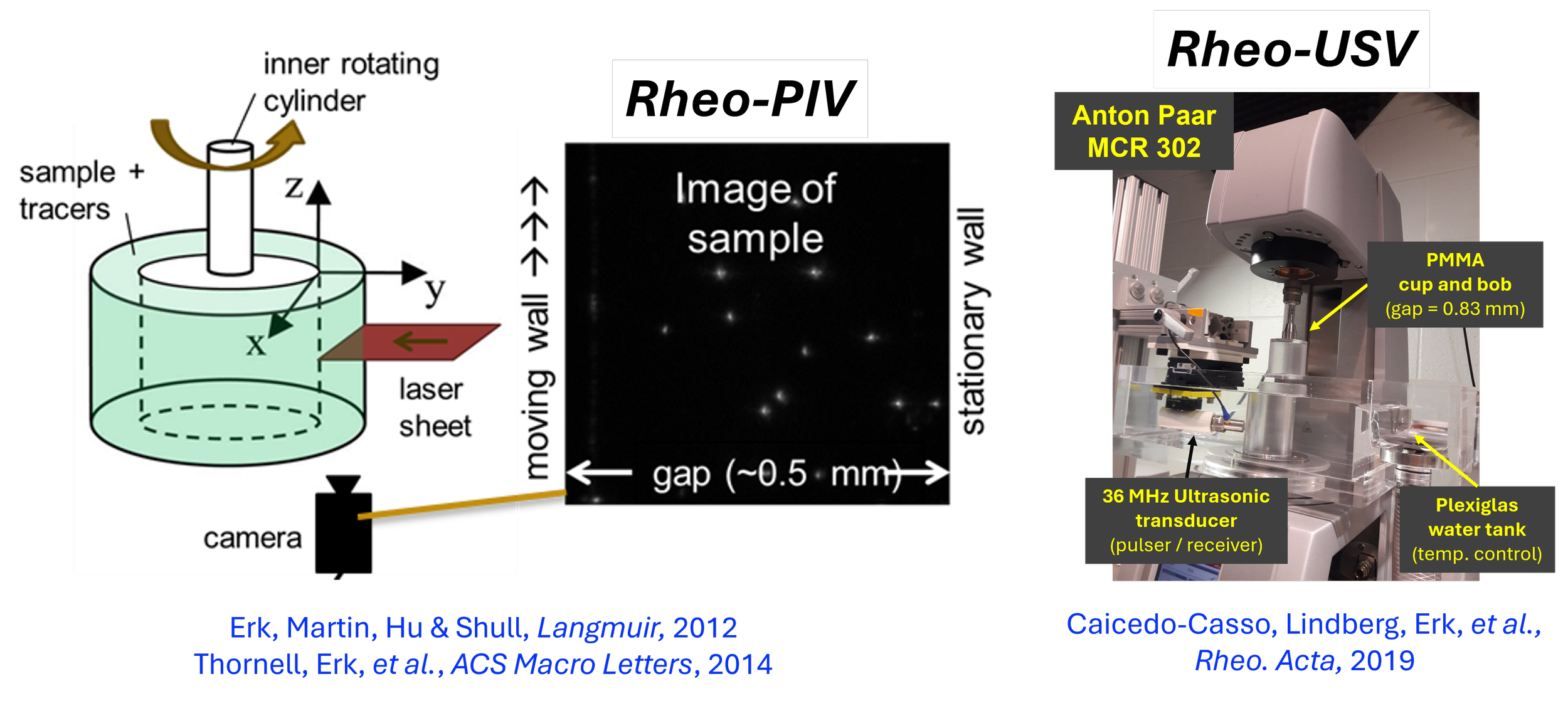
Custom flow-velocimetry systems integrated with our Anton Paar MCR 302: an optical system for transparent fluids (rheo-PIV) and an ultrasound system for opaque ones (rheo-USV).